
How to Engineer Buy-In: Strategic Narrative for Executives and Founders

In high-stakes professional environments—whether pitching a venture capitalist for a Series A, navigating a C-suite promotion, or positioning a startup for a market exit—qualifications are merely the baseline. They get you into the room, but they do not close the deal. In an era where AI-generated noise has turned "experience" into a commodity, the only remaining moat is Strategic Authority.
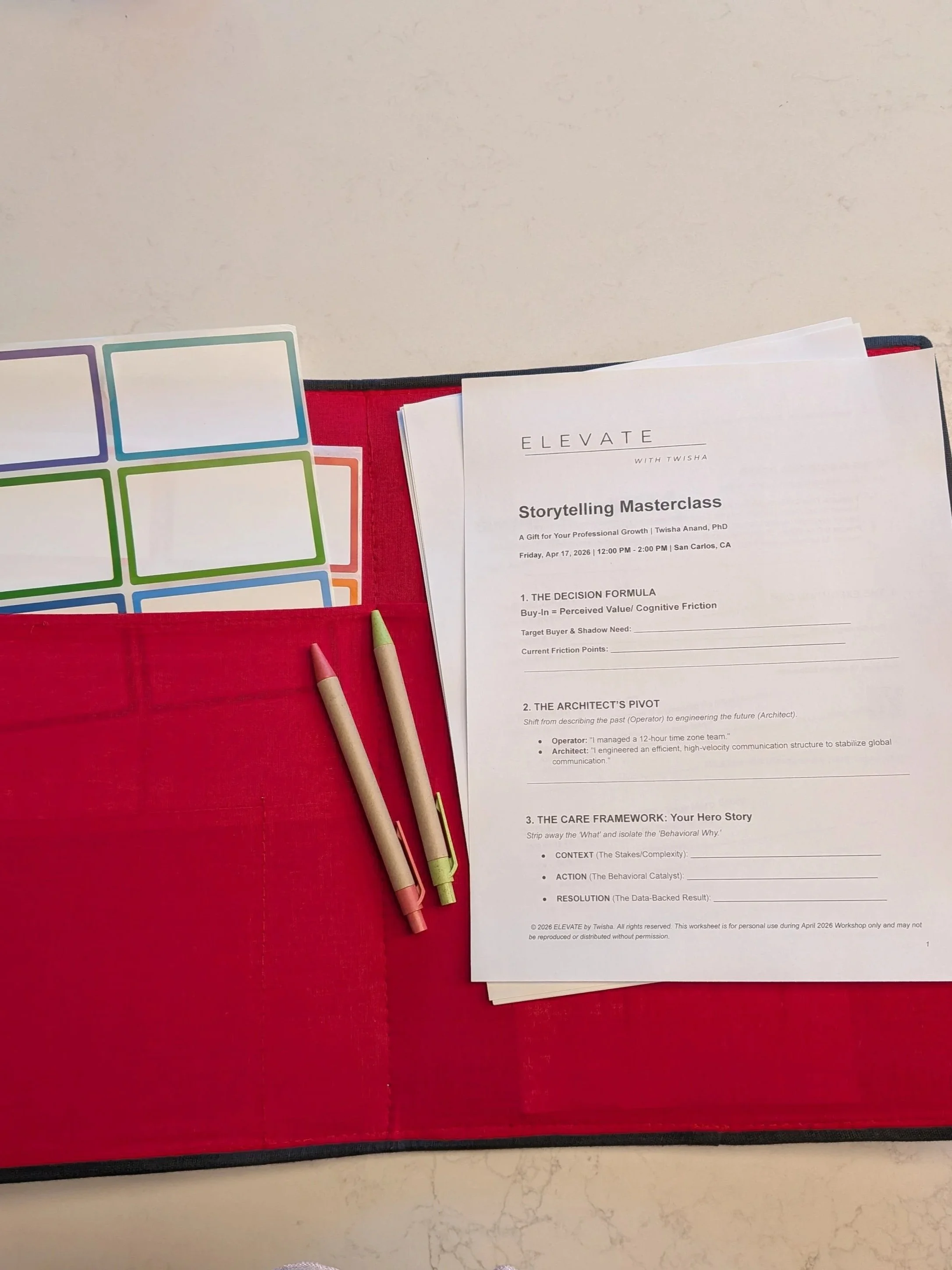
During the recent Strategy Gather in San Carlos, we deconstructed the behavioral science of narrative building. The room was a high-caliber mix of directors, VPs, and founders, all focused on one objective: moving beyond the "Operator" mindset—listing duties and titles—and embracing the role of the Strategist.
As a coach who has sat on both sides of the table—pitching as a startup founder and buying as a C-suite executive—I know that the difference between a "No" and a "Yes" often comes down to how you manage cognitive load.
Here is the shift required to restructure a narrative that drives buy-in and accelerates professional growth.
The Formula for Executive Buy-In
Most professionals approach a pitch by adding more information. However, high-performance leadership is about subtraction. To achieve buy-in, one must master a simple psychological equation:
Buy-In = Perceived Value\Cognitive Friction
The Value (The Numerator): This is the listener’s internal answer to "What’s in it for me?" To increase this, a narrative must provide specific, data-backed outcomes rather than vague descriptions.
The Friction (The Denominator): This is the mental effort required to decipher a message. Jargon, complex career histories, and "operator" language create cognitive friction. If a decision-maker has to work to understand your value, the default answer is "No."
The CARE Framework: Protecting the "So What?"

A common pitfall at the executive level is getting lost in the "Context" of a story. To maintain executive presence and authority, we utilize the CARE Framework (Context, Action, Results, Expansion).
While the tactical execution of this model is a deep behavioral dive reserved for the workshop room, the philosophy is centered on the Expansion—the strategic "So What." We spent the session stripping away the "What" and isolating the Behavioral Why. By focusing on how a specific past achievement acts as an insurance policy against a buyer’s current risk, we move the narrative from a passive memory to an active strategic asset.
3 Ways to Refactor Your Narrative Today
To begin closing the gap between where you are and where you want to be, apply these three shifts immediately:
Isolate Your "Complexity Tax": Review your current pitch or LinkedIn bio. Every time you use a word that requires the reader to pause and "translate" (jargon, internal acronyms, or vague verbs like "managed"), you are charging them a complexity tax. High-level authority requires zero friction. Identify one paragraph today and remove every word that doesn't contribute directly to a solved problem.
Audit the "Expansion Gap": Most professionals end their stories at the "Result." They say, "I increased revenue by 20%." A Strategist adds the Expansion: "...which means I have already solved the specific scale-to-exit friction your board is currently facing." If your story doesn't explicitly bridge the gap to the buyer's current pain point, the story hasn't finished yet.
Language Refactoring (Value-Driver vs. Operator): Scan your narrative for "Operator" verbs—helped, assisted, managed, worked on. Replace them with "Value-Driver" verbs—engineered, catalyzed, strategically aligned, optimized. This isn't just wordplay; it is a signal of your level of ownership and strategic depth.
Reframing the Transition: Executive Presence as a Constant
For those navigating career pivots or re-entering the market, the narrative shift is vital. In our discussion, we reframed transitions not as "gaps," but as strategic laboratory environments.
Whether managing a municipal commission, leading a non-profit board, or navigating a deliberate career pause, these are spaces where capital is raised, initiatives are grown, and stakeholders are managed. We audit these experiences to focus on high-level accomplishments, ensuring the narrative reflects a continuous, unbroken trajectory of leadership.

A Note of Gratitude
A special thank you to our venue partners at The Alexandria at San Carlos. The Board Room provided the perfect high-intensity, professional environment for the strategic "pressure cooker" triads and deep-dive audits we performed.
Elevating Your Authority
The transition from a high-performing professional to a world-class leader requires an objective audit of your professional story. If you are ready to design your next big move, it is time to align your narrative with your ambition.
Missed this session? These frameworks are best mastered through the peer-to-peer "pressure testing" we do in person. Join the next room of leaders at our upcoming Strategy Gather.