
The Great Flattening: How to Use Relational Intelligence in the AI Era As Your Ultimate Leadership Advantage
We are witnessing what I call the "Great Flattening". Across industries, technology is evolving in months, while organizations are taking years to adapt.

As artificial intelligence rapidly takes over technical strategy and financial modeling, the definition of what makes a successful manager is fundamentally shifting.
When algorithms drive the data, human empathy, relational intelligence, and advanced leadership skills are what actually keep a business functioning. For aspiring leaders and the academicians training them, understanding Organizational Behavior (OB) is no longer a soft skill. It is a mandatory survival tool.
This shift is precisely why I recently partnered with my IIMA senior, Prof. Richa Saxena, to teach a masterclass to the MBA cohort at Institute of Management Technology (IMT) Ghaziabad. We explored the core concepts from my curriculum, focusing heavily on how to lead with trust and connection when AI forces rapid structural adjustments.
The Market Reality: Automation Cannot Replace Context
Companies are currently eliminating middle management layers and widening spans of control to speed up operations. But this structural chaos creates a direct, severe drop in psychological safety for employees.
When leaders prioritize speed over human connection, the system breaks. We examined recent industry case studies that prove this:
Meta: The company laid off thousands of staff under the assumption that AI agents would pick up the slack. They quickly realized the technology could not prevent workflow disruption, confusing technological capability with organizational reality.
Klarna: After slashing headcount to showcase AI productivity, the company faced skyrocketing regulatory complaints because they eliminated the human contextual judgment needed for complex billing and fraud errors.
Ford: The automaker replaced physical inspection workflows with automated models. The AI failed on mechanical edge cases, leading to vehicle recalls and forcing the company to rehire veteran quality control engineers.
What Future Leaders Must Master
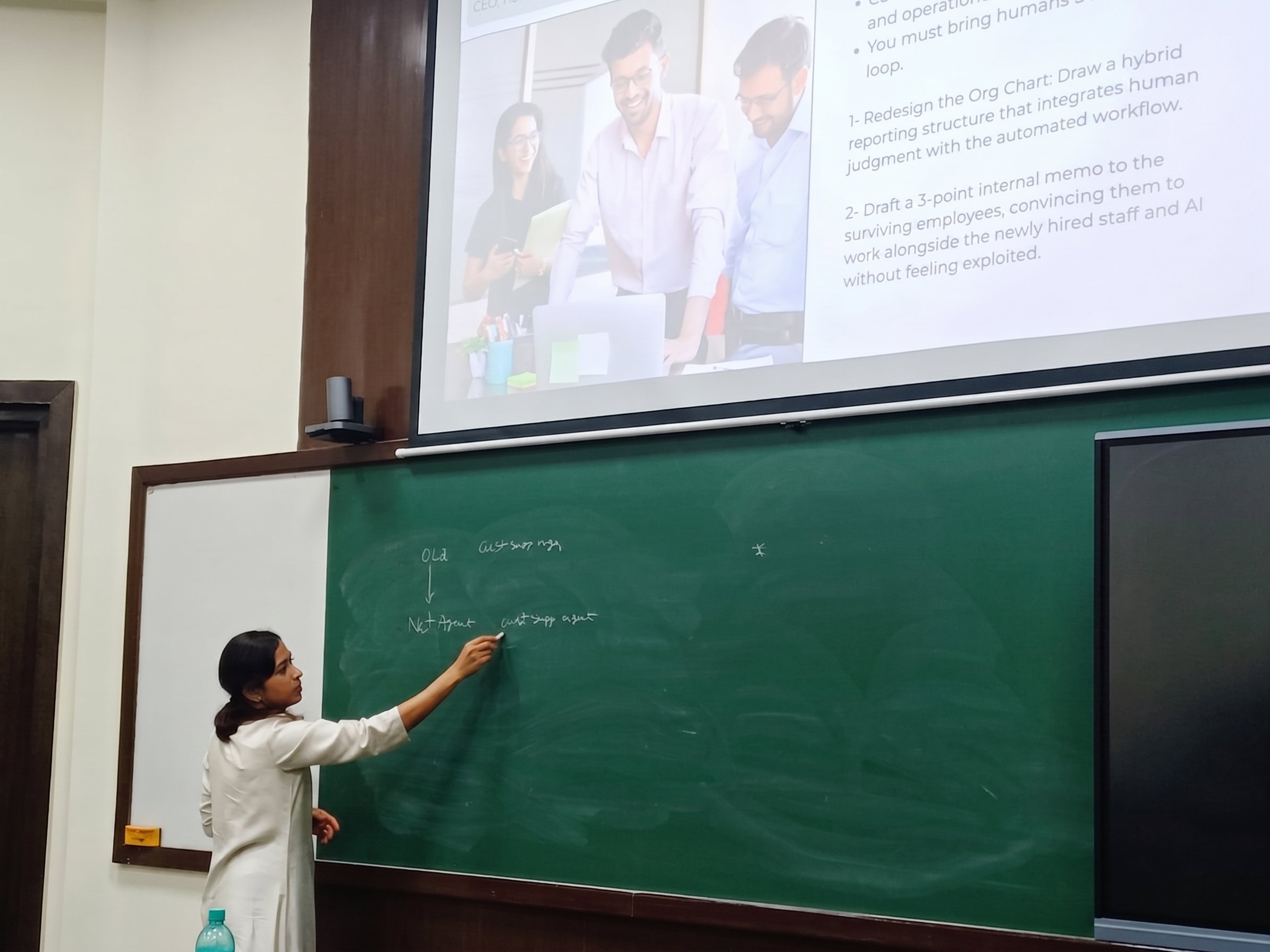
These highly public corporate missteps teach us an invaluable lesson: a "human-in-the-loop" structure is not just a safety mechanism. It is a collaborative communication bridge that prevents system-wide blindness.
To prepare the next generation of managers for these realities, I designed my IMT Ghaziabad session to be 20% applied theory and 80% tactical application. The students ran through live simulations where they had to act as a C-suite navigating a scenario where an automated AI system had failed. Their task was to redesign a hybrid reporting structure and draft an internal memo to restore employee trust.
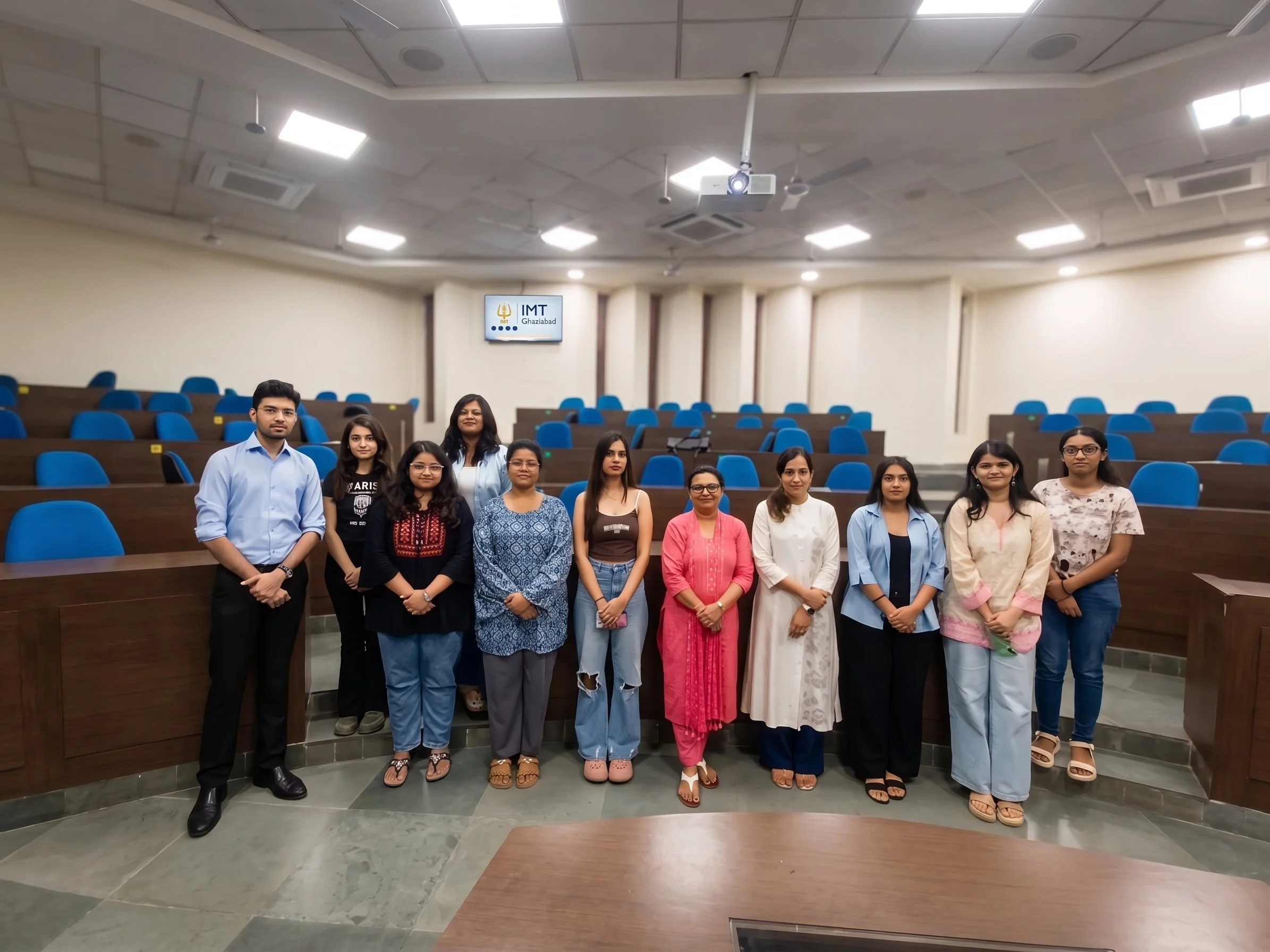
Through these exercises, the future managers learned the principles that will govern the next decade of corporate leadership:
Velocity is built entirely on trust and connection.
Workplace anxiety is fundamentally a design failure by leadership.
When managers are removed and systems flatten, help-seeking is perceived as a weakness, which completely kills the flow of knowledge within a company.

Bringing This Perspective to Your Cohort
Preparing the new generation of managers for an AI-integrated workplace requires moving beyond traditional textbooks and analyzing real-time market shifts. I applaud academicians who are actively bringing guest faculty into the classroom to bridge this gap.
I am actively expanding my work with universities and business schools globally to position students for what is coming next. If you are an academician looking to bring a futuristic, market-tested perspective on leadership to your campus, let us connect.
Reach out today to discuss guest lectures and workshop opportunities.